
India needs ‘UPI for EVs’, says Delhi panel. Digital infrastructure key to electrification

India’s electric vehicle push has mainly depended on policies, subsidies, and pilot programmes. But a new report by the Chintan Research Foundation argues that the next phase of India’s EV transition depends less on subsidies and more on investments and private capital.
“One of the major challenges with EVs is still range anxiety, but public charging infrastructure depends on utilisation. There is no consistent money in public charging points. It’s high risk and high cost,” said Shyamasis Das, Fellow at the Centre for Social and Economic Progress (CSEP) at a panel discussion about India’s EV Transition, organised by the Chintan Research Foundation (CRF).
Yet, over the past few years, EV sales have risen significantly, especially when it comes to two-wheelers and three-wheelers. This shift has been accompanied by government incentives, schemes such as FAME, and most recently, the new Draft Delhi EV Policy 2026-2030, which has been seen as one of the country’s most ambitious efforts to accelerate electrification.
Anuraag Nallapaneni, programme lead at the World Resources Institute of India, opened the panel discussion at Delhi’s India Habitat Centre with a question.
“Is today’s EV scaling held up by infrastructure, financing, or coordination challenges?” he asked the panellists.
Public charging infrastructure
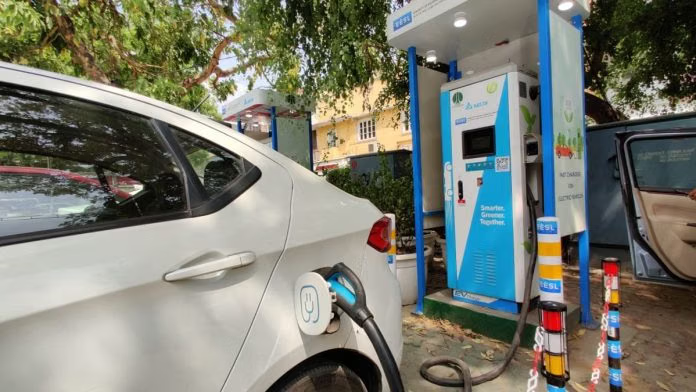
India’s EV charging points have often faced the same problem that lampposts once did—they get stolen when no one is paying attention. However, even with better surveillance, setting up charging infrastructure is a complicated task.
“You can’t just set up charging stations anywhere. You have to crunch movement data, study mobility patterns, find space and grid availability,” said Das.
At present, the demand for charging stations is low, and most are heavily underutilised. This makes them risky investments that offer no clear stream of revenue. Some experts suggest that charging companies could even partner with advertisers to make charging points more profitable.
IV Rao of The Energy and Resources Institute (TERI) has heard conflicting stories. Some people travel the length and the breadth of the country with an EV and face no trouble with charging points. But others say malfunctioning charging points are a frequent problem.
Fueling up
Abhishek Ranjan, CEO of BSES Rajdhani Power Limited, recalls having discussions about safe EV charging infrastructure even before Covid-19.
Ever since the invention of cars, refuelling has meant taking a trip to the petrol station. With EVs comes the concept of ‘destination charging’. To complement the rise of EVs, Ranjan said, this new type of charging infrastructure must come up—one that would turn hotels, officers, malls, restaurants, and parking lots across a city into charging locations.
Many EV owners might not be able to afford installing a high-capacity charger at their homes. Therefore, public EV charging infrastructure must focus on allowing people to charge their vehicles where they already spend time.
According to Ranjan, mobile charging services could be a potential solution. Instead of people having to hunt for chargers, charging units could travel to them.
“This would allow people to pre-book recharges, plan trips, and waste no time while charging,” said Ranjan.
Digital infrastructure and UPI for EVs
While many of India’s EV transition troubles are linked to physical infrastructure, the digital aspect cannot be ignored. Modern EVs are software-driven machines enabled by the internet of things. This allows charging operators to collect large amounts of data through fleet management and charging platforms.
Das sees the digitisation as an opportunity—with more EVs being digitally connected, the demand for charging will become easier to predict and manage. The data could even help in planning charging infrastructure, he said.
The infrastructure is currently fractured between different operators that have their own closed business and payment methods. But EV companies such as Fortum and Statiq have already begun partnering up.
“Companies need to realise that instead of dividing customers, they can collaborate, gain more customers, and have the cake together,” said Das.
Das compares this to the success of India’s UPI infrastructure. Although several net-banking apps and payment providers exist, they are connected through a common Unified Payments Interface. Something similar could also be created for EV charging.
“The attitude of ‘my charger, my app’ won’t survive,” said Das.