
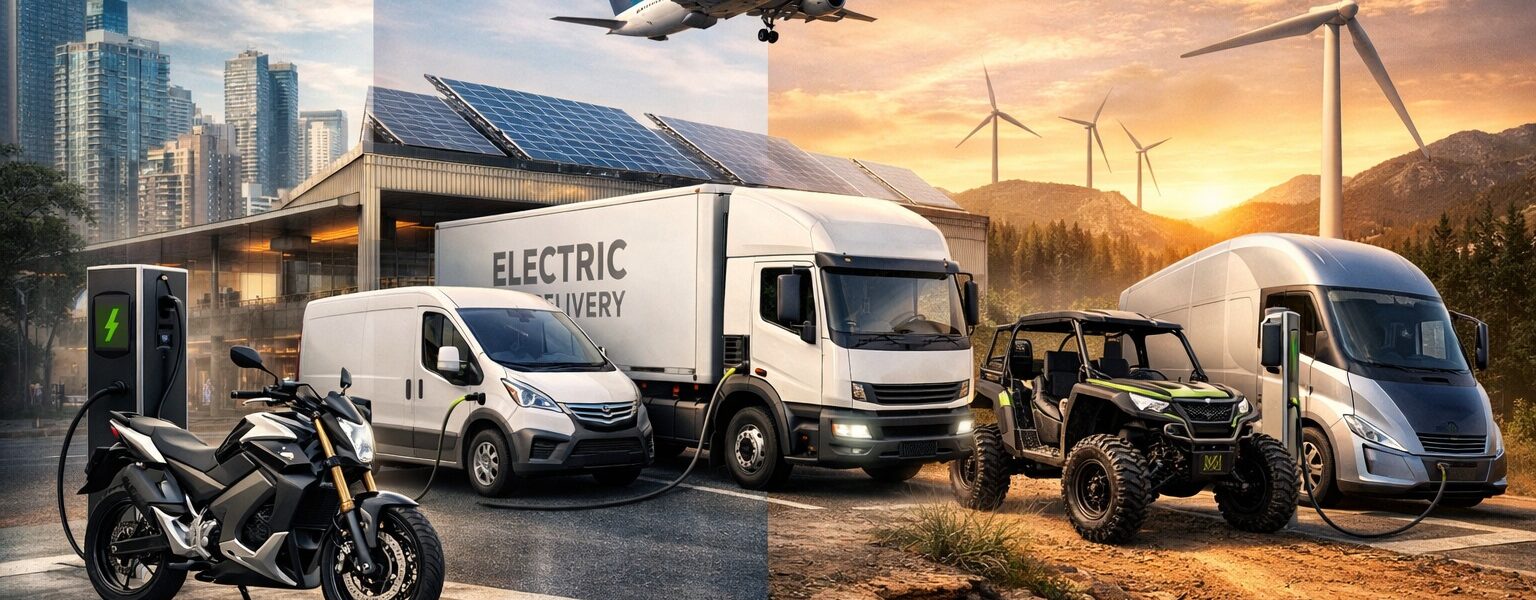
Electrification Beyond Cars: Two-Wheelers, Commercial Vehicles & Off-Road Mobility

While passenger electric cars dominate headlines, the real acceleration of electrification is happening beyond the traditional four-wheeler segment. Two-wheelers, commercial fleets, and off-road vehicles are rapidly adopting electric powertrains — often at a faster pace than private cars.
This broader electrification wave is transforming logistics, urban mobility, agriculture, construction, and last-mile transportation. For industry stakeholders, the opportunity extends far beyond the passenger EV market.
## Market potential and growth outlook
Electrification across non-passenger segments represents one of the fastest-growing areas in global mobility. Electric two-wheelers already account for a significant share of EV sales in several Asian markets, while electric buses and light commercial vehicles are scaling quickly in urban centers worldwide.
Industry forecasts indicate strong double-digit annual growth across these segments over the next decade, driven by lower total cost of ownership (TCO), fuel savings, government incentives, and stricter emission norms.
Unlike private passenger cars — where adoption is often consumer-driven — commercial and two-wheeler electrification is largely economics-driven, making the transition structurally resilient.
## Electric Two-Wheelers: Leading the Charge
Electric scooters and motorcycles are emerging as the backbone of affordable urban mobility, particularly in densely populated cities.
### Key growth drivers:
• High fuel cost savings compared to internal combustion models
• Lower upfront price gaps versus electric cars
• Government purchase subsidies
• Growing demand for app-based delivery services
• Improved battery range and charging access
Battery swapping models are also gaining traction in two-wheeler ecosystems, reducing downtime for commercial delivery riders.
## Commercial Vehicle Electrification
The commercial vehicle segment — including buses, light commercial vehicles (LCVs), and medium-duty trucks — is becoming a major electrification driver.
### Key segments:
• **Electric buses** for public transport
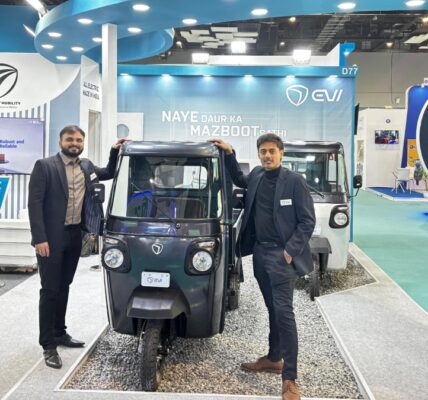
• **Last-mile delivery vans** for e-commerce logistics
• **Urban freight vehicles** operating in low-emission zones
• **Fleet vehicles** for corporate and municipal use
Commercial fleets benefit from predictable routes and centralized charging, enabling easier integration of depot charging systems. Total cost of ownership often becomes favorable within a few years due to lower fuel and maintenance costs.
Urban logistics electrification is especially strong as cities implement emission restrictions and zero-emission zones.
## Off-Road and Industrial Electrification
Electrification is expanding into traditionally diesel-dominated sectors such as agriculture, mining, and construction.
### Key applications:
• Electric tractors and farm equipment
• Construction machinery and excavators
• Mining haul trucks
• Airport ground support equipment
• Industrial material handling vehicles
These applications benefit from lower operational noise, reduced fuel logistics, and improved environmental compliance — particularly in enclosed or emission-sensitive environments.
## Key players and ecosystem evolution
The broader electrification market includes:
• Two-wheeler OEMs and startups
• Commercial vehicle manufacturers
• Fleet operators and logistics companies
• Battery manufacturers and swapping networks
• Charging infrastructure providers
• Industrial equipment manufacturers
Partnerships between OEMs, fleet operators, and energy providers are accelerating large-scale deployment across commercial and industrial sectors.
## Technology trends shaping non-car electrification
Several technology advances are enabling faster adoption:
• High-energy-density lithium-ion and LFP battery systems
• Battery swapping ecosystems for commercial two-wheelers
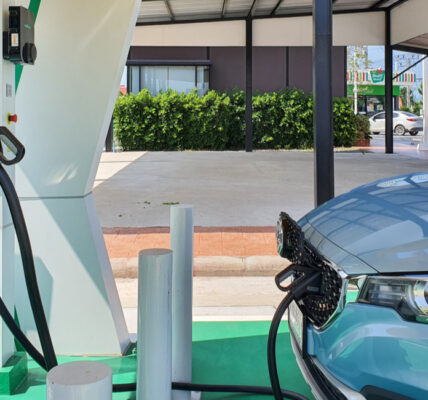
• Fast-charging depot solutions for fleets
• Telematics and fleet management platforms
• Ruggedized battery systems for off-road applications
Improved durability and modular battery architecture are particularly critical in commercial and industrial use cases.
## Key drivers and opportunities
Electrification beyond passenger cars is supported by:
• Lower total cost of ownership for fleets
• Government mandates for clean public transport
• Urban emission restrictions
• E-commerce growth driving last-mile delivery demand
• Sustainability targets among corporate fleets
• Rising diesel fuel costs
Emerging markets, where two-wheelers dominate mobility patterns, represent especially strong growth potential.
## Future outlook
Over the next decade, electrification in two-wheelers, commercial fleets, and off-road equipment is expected to outpace passenger EV growth in several regions. Fleet operators are likely to become early adopters of advanced battery technologies, smart charging systems, and Vehicle-to-Grid (V2G) integration.
Industrial electrification may also accelerate as carbon accounting and ESG reporting requirements tighten across sectors.
## Key market prospects
High-growth opportunities include:
• Electric last-mile delivery fleets
• Public bus electrification programs
• Battery swapping infrastructure
• Electrified construction and mining equipment
• Smart fleet energy management systems
These segments represent scalable, economically viable pathways toward decarbonizing transportation beyond private vehicles.
## Conclusion
Electrification beyond passenger cars is redefining the mobility transition. Two-wheelers, commercial fleets, and off-road vehicles are driving practical, economics-led adoption of electric powertrains.
As policy support, technology improvements, and cost efficiencies align, these segments will play a decisive role in reducing global transport emissions — proving that the EV revolution extends far beyond the traditional car market.