
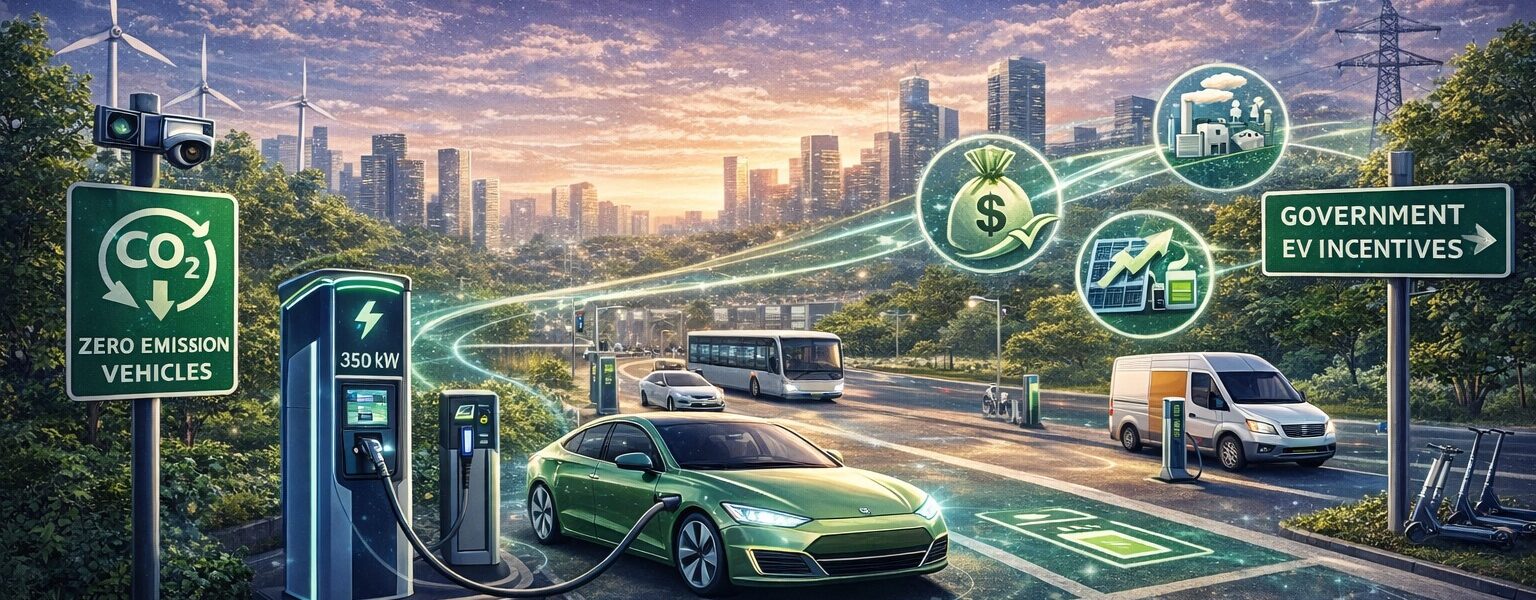

The global shift toward electric mobility is not driven by technology alone — it is strongly shaped by green regulations and policy incentives. Governments worldwide are introducing stricter emission standards, fuel economy mandates, and electrification targets to accelerate decarbonization of the transport sector.
These regulatory frameworks and financial incentives are creating a structured pathway for EV adoption, charging infrastructure expansion, and clean energy integration. For industry stakeholders, policy direction is now as critical as technological advancement.
Market impact and growth outlook
Green regulations have become a primary driver of EV market expansion. Emission reduction targets aligned with climate commitments are compelling automakers to accelerate electrification strategies. At the same time, financial incentives are reducing upfront costs for consumers and businesses, boosting demand.
As countries announce internal combustion engine (ICE) phase-out timelines and carbon neutrality goals, EV penetration rates are expected to rise sharply over the next decade. Policy-backed growth is particularly evident in Europe, China, and parts of North America, where regulatory certainty is encouraging long-term investments in battery manufacturing and charging infrastructure.
Key regulatory mechanisms shaping the market
Green mobility policies typically operate through multiple levers:
• **Emission and fuel economy standards** limiting allowable CO₂ output
• **ICE phase-out timelines** setting future bans on fossil-fuel vehicle sales
• **Zero-emission vehicle (ZEV) mandates** requiring a minimum share of EV sales
• **Carbon pricing and taxation policies** penalizing high-emission vehicles
• **Urban low- and zero-emission zones** restricting polluting vehicles
Together, these mechanisms are shifting both supply and demand toward electric mobility solutions.
Financial incentives accelerating EV adoption
Beyond regulatory pressure, governments are supporting the transition through economic incentives, including:
• Purchase subsidies and tax credits for EV buyers
• Reduced registration fees and road taxes
• Incentives for charging infrastructure installation
• Fleet electrification grants for commercial operators
• Manufacturing incentives for battery and EV production
These measures help bridge the cost gap between electric and conventional vehicles while encouraging domestic manufacturing and supply chain development.
Regional policy momentum
Policy-driven electrification is strongest in regions with clear long-term decarbonization roadmaps. The European Union continues tightening fleet emission standards and expanding zero-emission mandates. China maintains strong industrial policy support for EV manufacturing and infrastructure deployment. The United States has introduced large-scale federal funding and tax credits to strengthen clean energy supply chains.
Emerging markets are also adopting phased incentive programs to support early-stage EV growth while building local production capacity.
Recent developments in green mobility policy
Recent policy trends indicate increasing ambition. Many countries are accelerating ICE phase-out targets and expanding charging infrastructure funding. Carbon accounting standards are becoming stricter, and lifecycle emissions assessments are influencing regulatory frameworks.
Governments are also linking transportation electrification with renewable energy expansion, creating integrated clean energy ecosystems rather than standalone mobility policies.
Technologies supported by policy incentives
Green regulations are driving innovation across multiple technology segments:
• Electric vehicles and advanced battery systems
• Fast-charging and ultra-fast charging networks
• Smart charging and Vehicle-to-Grid (V2G) systems
• Hydrogen fuel cell mobility solutions
• Digital mobility platforms and smart traffic management
By creating regulatory certainty, governments are encouraging long-term private investment in these technologies.
Key drivers and opportunities
The policy-driven EV transition is supported by several structural drivers:
• Climate commitments aligned with net-zero targets
• Public health concerns related to urban air pollution
• Energy security and reduced fossil fuel dependence
• Industrial competitiveness in clean technology sectors
• Job creation within domestic EV supply chains
For businesses, green policy frameworks provide predictable market signals, enabling strategic investment planning in EV manufacturing, charging networks, and battery technology.
Future of regulatory-driven electrification
Over the next decade, regulatory frameworks are expected to become more comprehensive, covering not just tailpipe emissions but full lifecycle carbon impact. Incentives may gradually shift from purchase subsidies toward infrastructure and industrial policy support as EVs achieve cost parity.
Digital compliance monitoring and carbon reporting requirements are likely to increase, integrating transportation into broader climate governance systems.
Key market prospects
High-growth prospects emerging from green regulations include:
• EV manufacturing and battery localization
• Charging infrastructure deployment
• Fleet electrification services
• Clean urban mobility solutions
• Renewable-integrated transport systems
Policy certainty will remain a foundational pillar in sustaining long-term EV market growth.
Conclusion
Green regulations and policy incentives are not temporary support mechanisms — they are structural forces reshaping the automotive and energy industries. By setting emission standards, funding innovation, and guiding infrastructure investment, governments are accelerating the transition toward sustainable mobility.
As regulatory ambition increases globally, policy frameworks will continue to define the pace, scale, and direction of electric vehicle adoption — ensuring that the shift to cleaner transport remains both economically viable and environmentally impactful.