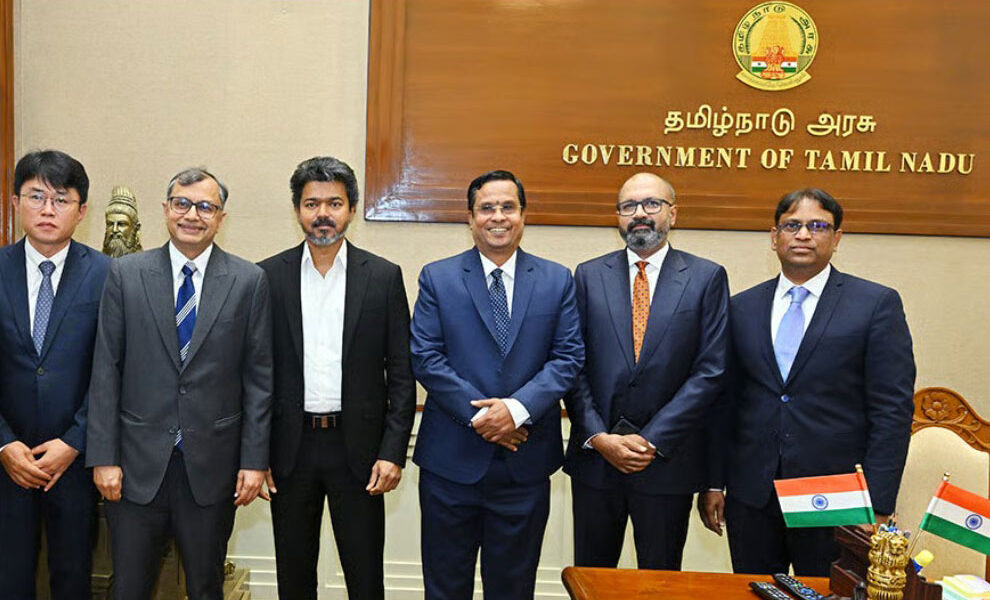

Hyundai Motor India has designated Tamil Nadu as its flagship electric vehicle hub for India and will launch two new models from its Chennai plant this year, including the company’s first mass-market dedicated EV. A skill development collaboration with the state government will begin in December 2027.
The company has committed INR260bn [US$2.6bn] to Tamil Nadu over 2023–2032. Localisation is to rise from 82% to 90%, with an INR40bn [US$400m] boost to supplier purchasing value.
In a statement, Tarun Garg, Managing Director and Chief Executive Officer of Hyundai Motor India, said: “HMIL’s initiatives will strengthen Tamil Nadu’s leadership in sustainable mobility and automotive excellence, while also accelerating skill development to foster a future-ready workforce. We will roll out two new models from the Chennai facility, including our first mass-market dedicated EV within this year, marking a significant step towards accelerating EV adoption and building a strong EV ecosystem. Alongside, advancing EV localisation, we are equally focused on developing a future-ready skilled workforce, enabling talent to support future automotive technologies. A true testimony to ‘Born in Tamil Nadu, Made for the World,’ HMIL has so far exported over 3.9 million vehicles made in Tamil Nadu to more than 150 countries, a shining example of how world-class manufacturing in the state is driving India’s journey towards becoming a global automotive powerhouse.”
Why this matters:
• The localisation target from 82% to 90% is the most commercially significant commitment in the announcement. At that level, Hyundai Motor India is approaching near-complete domestic sourcing for its Chennai output: reducing import exposure, improving cost competitiveness and strengthening the case for Tamil Nadu as a genuine manufacturing base rather than an assembly operation dependent on Korean supply chains. The accompanying INR 4,000 crore increase in Tamil Nadu supplier purchasing value and the projected 2,000 additional supplier jobs give that target a concrete economic shape.
• The mass-market dedicated EV launch this year is the near-term test. HMIL has the battery sub-assembly plant, the charging infrastructure and the government alignment in place. What has been missing from Hyundai’s India EV story is a volume product accessible to mainstream buyers rather than premium early adopters. The first mass-market dedicated EV from Chennai—for which details are not yet disclosed—will determine whether the broader EV hub ambition has commercial foundations or remains primarily an industrial policy narrative.
• The skill development partnership reflects a structural challenge the whole Indian automotive sector faces.Training Tamil Nadu’s workforce in EV powertrain technology, hydrogen mobility, robotics and AI-enabled manufacturing is not philanthropy; it is a supply-side investment in the labour pool that Hyundai’s own expansion, and the broader transition of Indian automotive manufacturing, will depend on. The December 2027 launch date and the ITI, polytechnic and engineering college network behind it suggest a programme with real institutional depth rather than a headline announcement without operational follow-through.