

Prime Minister Mark Carney said that the electric vehicle deal with China is an “opportunity” for Ontario and autoworkers, despite criticism from Premier Doug Ford and the union representing Canadian autoworkers.
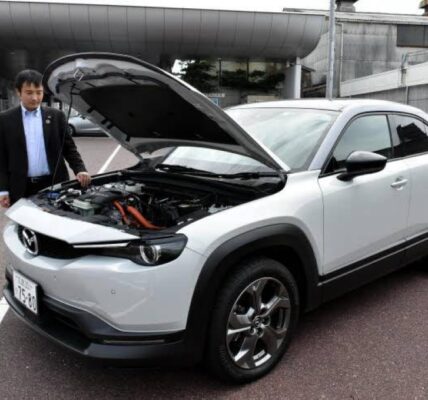
Speaking in Doha, Carney said there is interest in Chinese companies producing “affordable” electric vehicles in Canada.
“We’ve had direct conversations directly from the Chinese companies… with explicit interest and intention to partner with Canadian companies,” Carney said at a Sunday news conference.
“We’ll see what comes to pass. This is an opportunity for Ontario. It’s an opportunity for Ontario workers, opportunity for Canada, done in a controlled way with a modest start.”
The prime minister did not name any specific companies Canadian officials have had contact with.
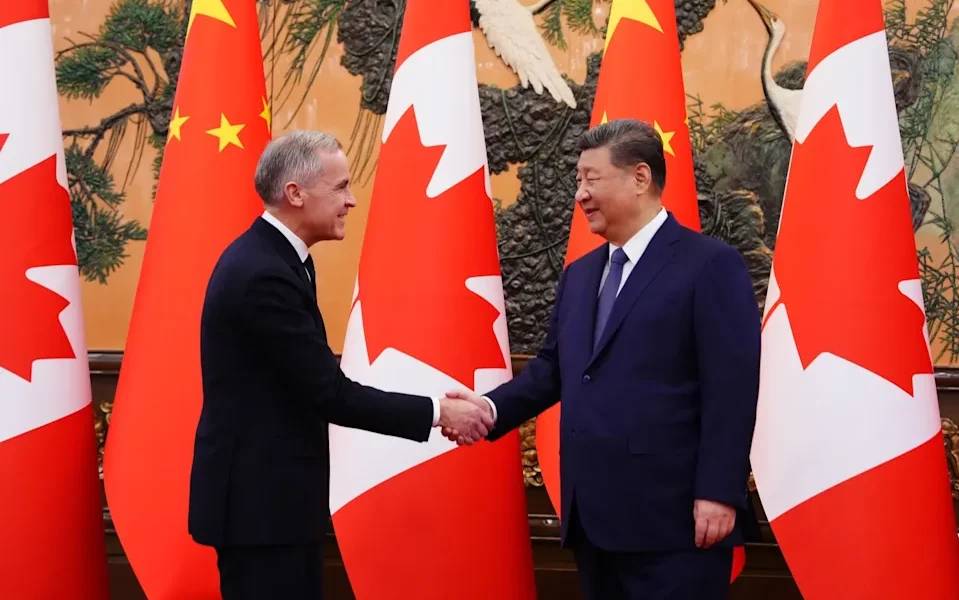
Carney and Chinese President Xi Jinping signed an agreement Friday that will see Canada allow Chinese electric vehicles into the country at a 6.1 per cent tariff rate.
The deal includes an annual import quota of up to 49,000 Chinese EVs, and 50 per cent must have an import price of under $35,000 by 2030.
Canada joined the U.S. in putting a 100 per cent tariff on Chinese electric vehicles in 2024, with accusations of unfair subsidies and dumping vehicles in the North American market.
Ottawa does not see granting Chinese electric vehicles favourable tariffs under a new quota scheme as an economic threat to the domestic auto sector because it plays into a larger strategy of eventually making Chinese EVs domestically – maybe even the first to do so in North America.
That’s according to a senior government source who briefed reporters on the plan during the prime minister’s flight from Beijing to Doha and was granted anonymity to speak frankly about the decision.
Ford said in a social media statement Friday that this deal runs the risk of flooding the market with cheap, Chinese EVs without guaranteed Canadian investment.
“Worse, by lowering tariffs on Chinese electric vehicles this lopsided deal risks closing the door on Canadian automakers to the American market, our largest export destination, which would hurt our economy and lead to job losses,” Ford said.
Lana Payne, Unifor president, said in a news release that this deal is a “self-inflicted wound” on an already hurting Canadian auto industry. She said that the U.K. and Brazil show that once China is allowed into an auto market, they quickly seize market share.
Michael Kovrig, a former Canadian diplomat in China who was one of two Canadians detained by Beijing for nearly three years and is now a senior adviser on Asia for the International Crisis Group, said that this deal is an example of “asymmetric coercion.”
Story Continues
Terms and Privacy Policy
Privacy Dashboard
The Canadian Press
Prime Minister Mark Carney looks to reset Canada-China relationship in Beijing
Anand says Ottawa seeking to ‘recalibrate’ relationship with ChinaScroll back up to restore default view.
Kyle Duggan
Thu, January 15, 2026 at 3:29 a.m. IST 7 min read
BEIJING — Prime Minister Mark Carney landed in Beijing on Wednesday for the first visit by a Canadian prime minister to China in eight years — part of his government’s efforts to rebuild Canada’s fractured relationship with China and expand non-U.S. trade.
After declaring in 2022 that China is a “disruptive global power” that does not share Canada’s values, the Liberal government is now shifting its China policy in the face of U.S. President Donald Trump’s attempts to upend global trade with tariffs.
Upon landing in Beijing, Carney posted on social media that the relationship between Canada and China has created prosperity on both sides of the Pacific.
“We’re ready to build a new partnership, one that builds on the best of our past and responds to the challenges of today,” Carney said on X.
He is travelling with several members of his cabinet, including Energy Minister Tim Hodgson and Foreign Affairs Minister Anita Anand.
“This is a new government with a new prime minister, a new foreign policy and a new geopolitical environment,” Anand told reporters in Beijing when asked if she still views China as a disruptive power.
“In this moment of economic stress for our country, it is necessary for us to diversify our trading partners and to grow non-U.S. trade by at least 50 per cent over the next 10 years.”
Since taking office last spring, Carney’s government has described Beijing as strategic partner. It recently advised two Liberal MPs to quit a Taiwan visit early to avoid confusion over Ottawa’s policy of not recognizing the self-governing island as an independent country.
Carney will spend two days in Beijing meeting with senior communist leaders and will sit down with President Xi Jinping on Friday. Carney and Xi also met last fall at the APEC summit in Korea.
The Canada-China relationship fell apart in 2018 after China detained two Canadians and held them in custody for nearly three years in retaliation for Canada’s arrest of a Chinese tech executive in Vancouver on a U.S. extradition warrant.
The visit comes after years of warnings about Chinese electoral interference in Canada, mounting human rights concerns involving the Uyghur minority and free speech in Hong Kong, and military actions aimed at broadening China’s territory beyond the nautical limits laid out by the United Nations.
Human Rights Watch has urged Carney to “make human rights a key focus of his visit,” arguing that “the Chinese government’s deepening repression threatens not just the rights of people in China but, increasingly, Canada’s core interests and values.”
A major topic of Carney’s meeting in China will be Beijing’s heavy tariffs on pork, canola and seafood, which were imposed after Ottawa ordered tariffs on Chinese electric vehicles, steel and aluminum.
Anand told reporters in Beijing Wednesday that conversations with Chinese officials have been “productive” and negotiations continue.