

Electric vehicles are slowly becoming a part of daily life in India. As more employees switch to EVs, companies are beginning to explore how to set up EV charging stations at office locations. Workplace charging not only supports sustainability goals but also makes commuting easier for employees who drive electric vehicles.
But as organizations begin planning the installation of EV chargers in parking areas, they often struggle to find a starting point. What approvals does one need? And more importantly, how does the installation process work? This blog explains the office EV charger installation process in simple steps so businesses can confidently bring EV charging to their workplace.
What are the essential steps for workplace EV charger installation?
Setting up EV charging at the workplace involves multiple technical and operational considerations. Following a structured approach can help simplify the process. Here is a practical step-by-step process to install EV chargers at the workplace.
1. Assess employee demand and charging behavior
Before starting the office’s EV charger installation, the first step is understanding how many employees need EV charging.
Many companies assume demand based on EV trends, but the best approach is to conduct a short internal survey. This helps answer questions such as –
1. How many employees already drive EVs?
2. How many are planning to buy one in the next year?
3. What type of vehicles do they drive?
This information helps determine the number of chargers required and prevents over-investment in infrastructure that may remain unused.
Another factor to consider is parking duration. Employees usually park their vehicles for six to eight hours. This means slow or moderate AC charging is often enough to recharge a vehicle during the workday.
Many workplaces begin with a few charging points and gradually expand as EV adoption increases.
2. Evaluate electrical capacity and power readiness
Once demand is estimated, the next step is checking whether the building’s electrical system can support EV charging.
EV chargers draw a significant amount of electricity, especially if multiple vehicles charge simultaneously. Because of this, companies must assess the sanctioned electrical load available in the building or campus.
If the existing load is insufficient, the facility manager may need to apply to the local distribution company for an increase in power supply.
A technical assessment usually includes:
1. Available transformer capacity
2. Distribution board capacity
3. Dedicated circuits for charging equipment
4. Future expansion requirements
This step ensures that EV charging does not interfere with the normal operation of the office building.
3. Choose the right type of EV charger
Not all EV chargers serve the same purpose. Selecting the right charger is one of the most important decisions when planning to install an EV charger in a corporate campus parking area.
The two most common types are –
AC chargers
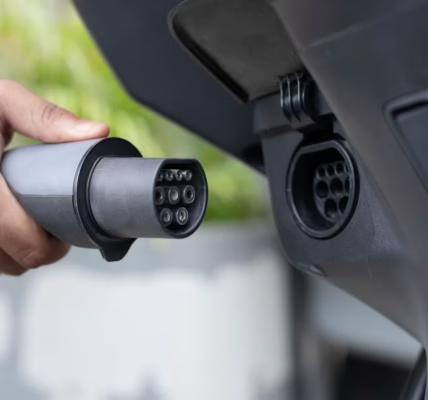
AC chargers are commonly used at homes and workplaces. They draw alternating current from the grid, which the vehicle converts to DC to charge the battery. Typical AC chargers deliver 3–7 kW for homes and offices and up to 11–22 kW in public setups, making them ideal for vehicles parked for several hours.
Because they are simpler and less expensive, AC chargers are widely used in residential societies and office parking spaces.
DC chargers
DC chargers deliver high power and charge vehicles much faster. They are more expensive and are typically used in fleet depots or public charging hubs where vehicles need quick turnaround.
Indian EV charging infrastructure follows national standards such as the IS 17017 series, which define system-level specifications for EV charging, supported by related standards governing connectors and interfaces.
Together, AC and DC chargers shape how an EV charging ecosystem functions in practice, influencing everything from usage patterns to infrastructure planning. To get a more holistic understanding, it is important to look at how the entire EV charging journey comes together.
Tata Power EV charging AC home and DC fast charging
Setting up an EV charging station at office creates a sustainabilty-led ecosystem
4. Identify the optimal location for EV charger installation
Choosing the right installation location can significantly affect cost and usability.
Most companies install chargers in employee parking areas, but several practical factors must be considered. The charging location should be close to the building’s electrical supply to minimize wiring costs.
A well-planned charging zone should –
1. Provide easy access for EV drivers
2. Allow safe vehicle movement
3. Be clearly marked with signage
4. Leave room for future expansion
Proper markings and signage should also be added, so the charging spots remain reserved for EV users.
5. Work with certified installers and follow safety standards
EV charging equipment must always be installed by qualified electricians or certified charging solution providers, such as Tata Power EZ CHARGE, which offers end-to-end EV charging solutions for workplaces.
Installation usually includes several technical steps –
1. Running electrical cables from the distribution board
2. Installing protective devices such as circuit breakers
3. Mounting the charger on walls or stands
4. Connecting connectors and charging cables
5. Testing the system for safety and performance
National guidelines also require charging infrastructure to follow technical standards defined by the Central Electricity Authority and Bureau of Indian Standards.
Proper installation ensures safe charging and prevents electrical risks.
6. Define a clear workplace EV charging policy
Once the chargers are installed, companies must decide how the system will be managed.
Some organizations offer charging as a free employee benefit, while others charge a small fee based on electricity consumption. Software platforms can also be used to monitor charger usage, track energy consumption, and manage access.
Typical workplace charging policies include –
1. Free charging for employees
2. Time limits to avoid parking congestion
3. Paid charging through mobile apps
4. Dedicated EV parking spots
Clear policies help ensure fair access and smooth operation.
AC chargers win at workplaces because cars stay parked for hours
Bottomline
Workplace EV charging is quickly moving from a nice-to-have to a business essential. It offers organizations a practical way to support employees while strengthening their sustainability commitments. With the right planning, office EV charger installation can be simple and scalable. By assessing demand, selecting suitable chargers, and following national safety standards, organizations can build reliable EV charging infrastructure within their campuses. Companies that install EV chargers in corporate campus parking areas today are not only supporting cleaner mobility but also preparing their workplaces for the future of transportation in India.