
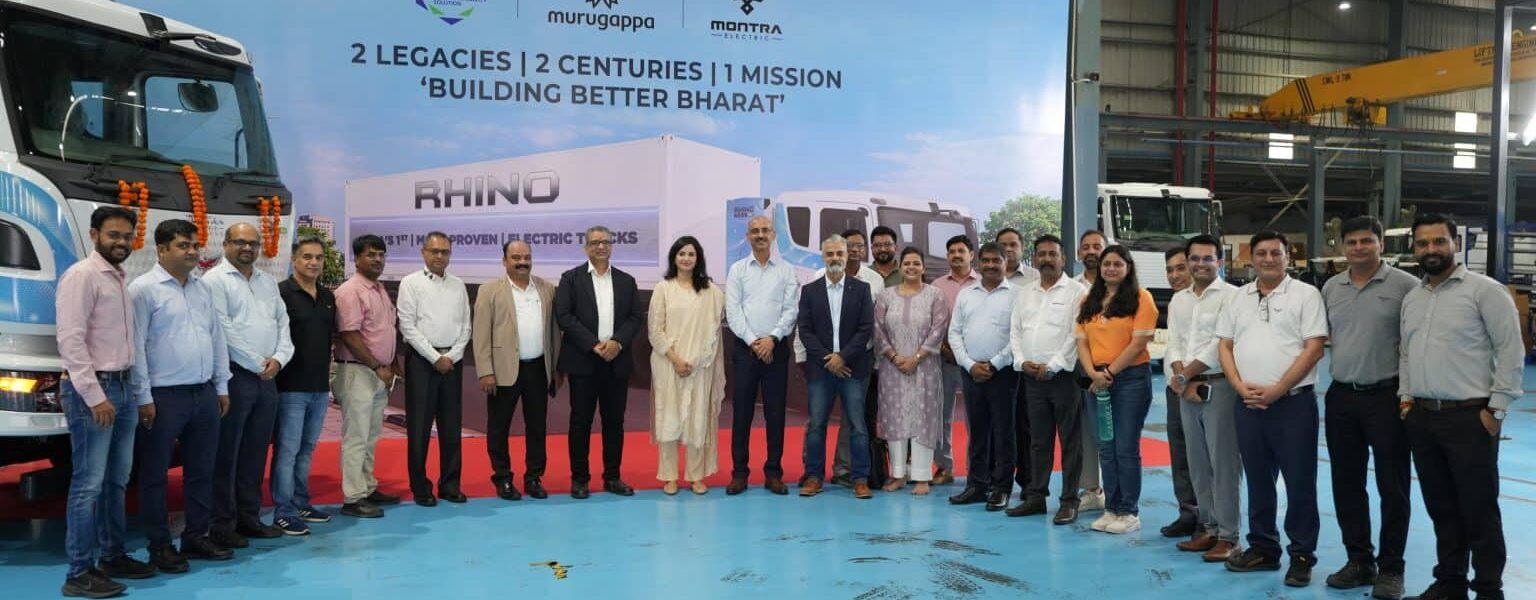

TVS Vehicle Mobility Solutions (TVS VMS) has entered electric trucking through a strategic collaboration with Montra Electric’s eM&HCV division, deploying its first fleet of electric heavy commercial vehicles for live freight operations.
The initial deployment involves 57 Montra Electric Rhino 5538 EV 4×2 TT trucks, which were flagged off at Manesar on August 8. The trucks will operate on a primary logistics route in Chhattisgarh, covering a 190 km lead distance. Three dedicated charging stations will support the route.
The deployment marks TVS VMS’s first move into electric trucking after more than seven decades of operating conventional trucks. The company said its fleet operations will integrate vehicle leasing, driver operations, maintenance, insurance, charging infrastructure and connected telematics.
Companies target 300 e-trucks
Montra Electric and TVS VMS plan to deploy more than 300 electric trucks during FY 2026-27 as part of their collaboration. The companies said the deployment is intended to support lower operating costs and reduced total cost of ownership for freight operations.
Montra Electric CEO Navneet Sethi said the deployment provides an opportunity to assess electric heavy commercial vehicles under sustained freight conditions, particularly in industries involving heavy loads and continuous haulage.
TVS VMS CEO Madhu Raghunath said the partnership would combine the company’s fleet lifecycle management capabilities with electric vehicles and supporting infrastructure to enable zero-emission commercial operations.
Rhino 5538 designed for heavy-duty freight
The Montra Rhino 5538 EV 4×2 TT is manufactured at Montra Electric’s facility in Manesar. The 55-tonne Gross Combination Weight electric tractor-trailer is designed for long-haul applications.
The truck uses a 282 kWh lithium iron phosphate battery and a Permanent Magnet Synchronous Motor, producing 280 kW of peak power and 2,000 Nm of torque. It has 18% gradeability and a six-speed Automated Manual Transmission.
The truck has a tested range of up to 198 km per charge on a one-way loaded and one-way empty duty cycle. It is offered in fixed-battery and battery-swap configurations. The fixed-battery version can charge from 20% to 100% in around 60 minutes, while the battery-swap configuration enables battery replacement in less than six minutes.
The companies said the deployment will provide a live operating environment for evaluating electric heavy trucks on high-utilisation freight routes.