
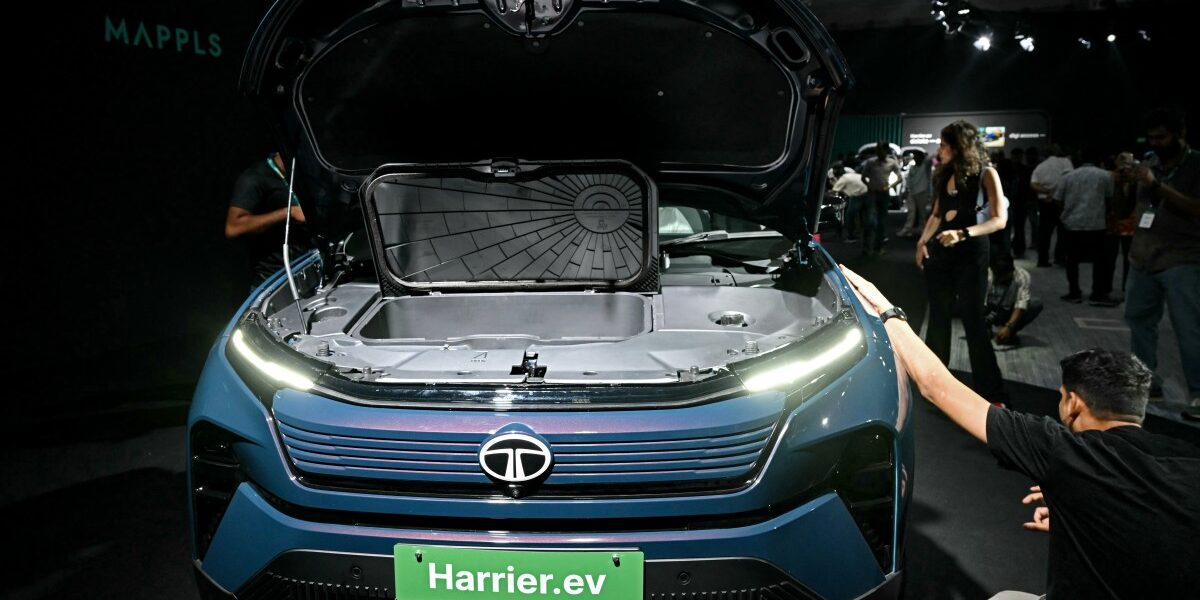

NEW DELHI – As growth in electric vehicle (EV) sales slows down in the US and Europe, competition is accelerating in India’s nascent electric car market with the entry of billionaire Elon Musk’s Tesla and Asian carmakers, such as Vietnam’s VinFast and China’s Leapmotor.
India is the world’s third-largest car market in terms of domestic vehicle sales, and it is predicted to overtake the US and China to become the largest by 2030.
The government hopes that electric cars will make up 30 per cent of total car sales by then, up from a mere 2.5 per cent out of the 4.3 million cars sold in 2024.
But India is also a challenging market with price-conscious consumers, limited charging infrastructure, difficult road conditions, and high import duties on foreign cars.
Telsa drove into the Indian market in July with two variants of its Model Y, a popular electric sport utility vehicle (SUV), which come with a hefty starting price tag of around US$70,000 (S$90,000), compared with just US$37,490 in the US, according to Forbes India.
A key reason was the import duty, which can rise to 110 per cent, making the SUV more expensive in India than in many other countries.
Tesla, which is currently operating in Mumbai and plans to expand to Delhi, is testing the market, said Mr Srihari Mulgund, India new age mobility partner at EY-Parthenon India, a consulting company.
“They are trying to see how the market perceives the product. There will be learning, and it will help them develop an India product strategy,” he noted.
The government is working to expand infrastructure for charging EVs, which will be key to their acceptance. More than 12,000 EV charging stations were in use nationwide in 2024, and the government aims to have 3.9 million by 2030.
Leading up to Tesla’s entry on July 15, Mr Musk had criticised the high import duties, remarking that they were “the highest in the world by far, of any large country”.
The US is negotiating lower automotive tariffs as part of the India-US trade deal.
Tesla, which competes in the luxury EV sector, has ruled out manufacturing in India, according to Heavy Industries Minister H.D. Kumaraswamy.
Operating on a different model in another part of the cost spectrum is Vietnamese EV-maker VinFast, which was named one of Time’s 100 most influential companies in 2024.
It is taking orders for two premium SUVs, which will be priced in the range of 1.8 million rupees (S$26,500) to 3.5 million rupees, according to Indian media reports.
VinFast opened its first showroom in the city of Surat, in the western state of Gujarat, on July 27, and its second in the city of Chennai, in the southern state of Tamil Nadu, on Aug 2. It has also tied up with local partners to create a charging network and for after-sales service, with plans to launch 35 dealerships by the year end in 27 cities.
According to VinFast’s press release, its car assembly plant in Tamil Nadu is the company’s third operational facility globally. The facility, which is part of a 160 billion rupee investment pact inked between VinFast and the Tamil Nadu government in 2024, will initially make 50,000 vehicles per year.
VinFast Asia chief executive Pham Sanh Chau told NDTV news channel: “This plant lays a solid foundation for us to make Tamil Nadu not just a manufacturing hub for India, but also VinFast’s largest export base for South Asia, the Middle East and Africa.”
Mr Puneet Gupta, director for India and Asean markets at S&P Global Mobility, said: “Tesla and VinFast will both serve as catalysts in driving up EV market share in India. They are expected to attract greater attention from consumers towards electric vehicles and help increase confidence in EV technology.”
Chinese automobile start-up Leapmotor’s electric cars are also being launched in India, by multinational automotive manufacturing corporation Stellantis, which will assemble the vehicles.
India is hoping that such assembly plants, which are at the lower end of manufacturing, will be the starting point for building a manufacturing ecosystem of EVs.
While domestic EV manufacturers are keen to protect their turf, the government is encouraging foreign carmakers to come to India and make it their EV manufacturing hub in the region.
Consumers with higher purchasing power are turning to EVs
Sales of electric cars are inching up in India, the world’s fourth-largest economy.
In 2024, 99,165 electric cars were sold, which is a 20 per cent increase over the previous year, according to the Federation of Automobile Dealers Associations. EV growth in India has been led by two- and three-wheelers that accounted for a majority of the over two million EVs sold in 2024.
The growth is not coming from the entry-level segment, but SUVs – where cars start at around one million rupees – and the premium segment.
Consumers with more purchasing power, who own more than one car and are aware of environmental concerns, are likely leading the trend, said analysts.
When Mr Surinder Gera decided to replace his 11-year-old diesel car with an electric SUV, he spent as much time convincing his 21-year-old son, with whom he runs the family clothing manufacturing business, as he did researching cars and the charging infrastructure. The family already owns a petrol car.
“He told me it’s too much of a risk, as we travel a lot for our business. But I convinced him. I wanted to bring down my family’s carbon footprint,” said the 47-year-old businessman, who is based in the northern Indian city of Ludhiana.
In addition, Mr Gera charted every location he had visited in the last five years to see whether charging stations were present along each route.
He settled on an SUV made by domestic automobile company Mahindra & Mahindra, which fell within his budget. Mahindra’s electric car line-up starts at around 1.5 million rupees.
Vocal for local
Unlike in other parts of the world, where Chinese EV companies have been rapidly increasing their market share, domestic manufacturers dominate the market in India.
China’s BYD’s, the world’s biggest EV-maker, had a US$1 billion investment plan rejected in 2023 amid geopolitical tensions between India and China.
So BYD scaled down its plans for India and relies on its assembly plant in the southern city of Chennai, which has an annual capacity of 10,000 to 15,000 units. BYD also imports many of the cars it sells in India.
Things may improve for Chinese companies as China and India seek to repair ties following a 2020 clash on their border.