

IPO-bound Dhoot Transmission expects India’s shift to electric vehicles to drive growth as the auto components maker expands its product portfolio and ties with automakers, a top executive said.
Chhatrapati Sambhajinagar-based Dhoot Transmission makes wiring harnesses for automotive and industrial applications. Bajaj Auto , India’s biggest two-wheeler exporter, accounted for about a third of its annual revenue of 45.3 billion rupees in fiscal year 2026.
“Electrification will be the biggest growth driver for us, with premiumization following close behind,” Nitin Kalani, chief financial officer at Dhoot Transmission, said in an interview ahead of the company’s $322.21 million initial public offering.
The Bain Capital-backed firm’s IPO, which includes the sale of fresh shares worth 14 billion-rupee, opens on Aug. 10 and closes on Aug. 12, with trading likely to begin on Aug. 17.
India’s EV transition is being led by two- and three-wheelers, as lower vehicle prices and shorter urban journeys make electrification more viable in those segments.
Dhoot Transmission expects to benefit from the greater wiring-harness content in EVs compared with internal combustion engine vehicles.
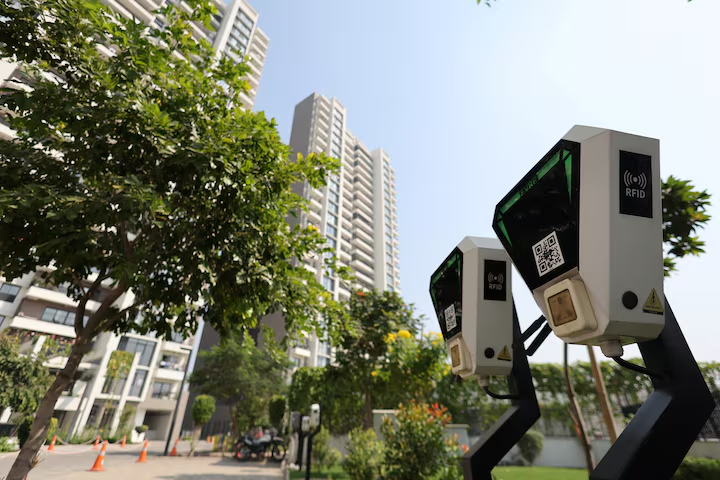
Beyond harnesses, the company is building an EV-focused product portfolio that includes battery assemblies, onboard chargers, DC-DC converters and charging guns.
The shift is also reflected in Dhoot’s non-harness portfolio, which rose to 23% of revenue currently from about 18% in fiscal 2024.
Dhoot has spent about 10 billion rupees on capital expenditure over the past four to five years and expects similar investment to support growth and capacity expansion.
Despite the investment, Kalani said annual margins should remain sustainable at 15%-16%, broadly in line with current levels.