
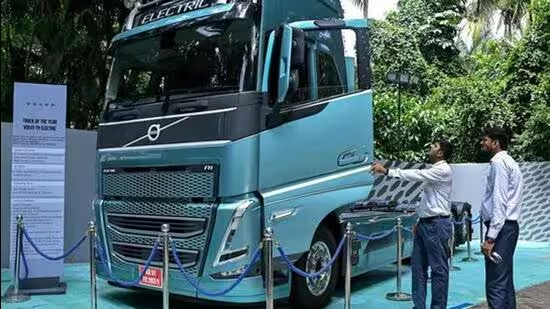

Heavy-duty electric trucks in India are on the verge of achieving commercial cost parity with diesel vehicles, according to a report released on Thursday that positions battery electric trucks (BETs) as a viable option for the country’s long-haul freight sector. Electrification of trucks is key to decarbonising India’s transport sector in line with India’s broader net-zero ambitions as trucks contribute to around 50% of emissions.
Electrifying Indian Highways: A Guidance Framework for Zero-Emission Freight, developed by C40 Cities and The Climate Pledge, found that 55-tonne electric trucks currently have a total cost of ownership (TCO) only 3-4% higher than comparable diesel vehicles and are expected to achieve full parity within a year. For 14-tonne and 19-tonne truck segments, the cost gap currently ranges between 10% and 24%, but the report estimates these categories could reach parity within three to four years.
The findings are based on operational data from the Laneshift pilot project conducted along the Bengaluru-Chennai highway corridor and come amid growing efforts to decarbonise India’s freight sector, where demand is projected to increase fivefold by 2050. The pilot deployed 20 battery electric trucks across 14T, 19T and 55T categories on the Bengaluru-Chennai route. The fleet completed 600 trips and covered more than 208,819 km during the pilot. Operating under a “Trucking-as-a-Service” (TaaS) model, the pilot tested electric trucks across six industrial use cases and found that BETs could match diesel turnaround times when backed by adequate fast-charging infrastructure.
The report identified utilisation as the key determinant in making electric freight commercially feasible. It noted that monthly utilisation above 9,000 km, typical in e-commerce and retail operations, significantly improves the economics of electric trucks.
Policy support could further accelerate adoption. According to the report, toll waivers for electric trucks on national highways could reduce total ownership costs by as much as 11%, effectively eliminating the remaining price premium for several operators.
Alongside the cost analysis, the framework proposed a graded three-phase roadmap to develop a contiguous EV-ready highway network across the country by 2035.
The first phase, from 2025 to 2027, focuses on electrifying 20 high-volume national highway corridors identified by the ministry of heavy industries. The report said this stage is aimed at creating replicable models for return-to-base freight operations.
The second phase, between 2027 and 2030, envisages expanding the network to connect industrial belts, logistics parks and ports adjoining these corridors, shifting from isolated charging stretches to integrated regional freight ecosystems.
The final phase, spanning 2030 to 2035, proposes a pan-India network that would support mainstream adoption of electric freight for interstate long-haul movement.
A separate study by the International Council on Clean Transportation (ICCT) released on Tuesday said transport nagars (truck terminals) will also serve as the vital interface of the ecosystem. Analyzing Sanjay Gandhi Transport Nagar in Delhi, Asia’s largest terminal, the study found that supporting electric trucks will require massive peak installed capacity in phases —1.8–2.3 MW by 2030, 7.7–10.3 MW by 2035 and 18.4–24.1 MW by 2040.
The ICCT paper also said Battery Energy Storage Systems (BESS) will also play a pivotal role estimating that a 2.3 MWh BESS could reduce peak charging demand by approximately 20% in 2030 under high-power scenarios.